
Inside Tift County Tax Records
A Tift County tax search really runs across two official files. The Board of Tax Assessors maintains the parcel card and all valuation data. The Tax Commissioner handles billing, collection, delinquency, and tax sales. Place the same parcel number and tax year side by side across both records. The picture gets much clearer.
| Tax record field | What it answers | Official keeper |
|---|---|---|
| Fair market value | The assessor's estimate of full value for the tax year | Board of Tax Assessors |
| Assessed value | The taxable assessment base before applicable exemptions | Board of Tax Assessors |
| Exemptions | Relief reflected on the assessment record | Board of Tax Assessors |
| Bill and payment | Amount billed, paid, or still due | Tax Commissioner |
| Delinquency or sale | Collection and tax-sale information that requires current confirmation | Tax Commissioner |
One caution belongs here. A tax bill is not a deed, and it proves nothing about title. The assessor's owner field is administrative too. It can lag a recent closing. It can also list an estate, trust, or company instead. For a real title question, match the parcel to the latest instrument. That instrument is recorded by the Clerk of Superior Court.
Search Tift County Property Tax
The direct qPublic search accepts owner name, location address, parcel number, and legal information. That covers nearly every angle a Tift County property search needs. The direct page can also sit behind a browser check. Results may not open on the first try. When that happens, the county landing page and the office itself are the sound starting points.
| Search choice | Best starting value | Use in the tax trail |
|---|---|---|
| Owner | Last name or recorded entity name | Find likely current parcel cards |
| Location | Situs street address | Match the physical tax parcel |
| Parcel | APN from a prior bill or map | Carry one stable key between offices |
| Legal information | Lot, land lot, district, or description term | Resolve address gaps and older tracts |
Keep two addresses straight. The situs address points to the land itself. The tax mailing address tells the county where notices and bills go. The gap between them matters often, especially after an owner moves or when a parcel sits vacant.
Tift County Tax Bill Route
The county's GovernmentWindow payment route is the official channel for paying a current Tift County tax bill. The payment screen sits behind a verification prompt, so its live search labels can shift. Bring the parcel number from qPublic, and keep the tax year attached to every result you save.
- Find the parcel card by address, owner, parcel number, or legal information.
- Write down the parcel number, assessed value, exemptions, and tax year.
- Open the Tax Commissioner payment route and locate the matching account.
- Compare the current bill with payment, delinquency, and any tax-sale information shown.
- Contact the office when the portal blocks access or a prior-year item is missing.
A receipt proves one thing only: the payment posted. It says nothing about liens, deeds, or estate issues still attached to the parcel. For ownership or encumbrances, go to the land-record index.
Georgia Value Terms in Tift
Georgia separates the estimate of full value from the assessed amount. The assessed amount is what the tax math uses. The Department of Revenue valuation overview sets the standard assessment level at 40 percent. Exemptions come off next. The millage rate then applies to the taxable assessment that remains.
- Fair market value
- The assessor's estimate of what the property would bring in an arm's-length sale.
- Assessed value
- Georgia's taxable value base, generally 40 percent of fair market value.
- Millage
- A tax rate expressed in mills and applied to taxable assessed value.
- Homestead exemption
- Qualified relief tied to an owner-occupied home and the governing rules.
- Tax lien
- A public claim tied to unpaid tax, which needs current office confirmation.
Every one of these values is tied to a tax year. A deed's sale price can differ because it captures a single transaction. An appraisal is separate again: a professional opinion made for a stated purpose.
Tift County's 2024 Revaluation
Tift County's revaluation notice laid out field work performed in 2023. Those values became effective January 1, 2024. Appraisers reviewed property characteristics, photographed parcels, and measured structures. Owners would receive an assessment notice, the document said. Each notice opens an appeal route.
The timing explains a lot of apparent disagreement between records. Compare the value year, the notice date, and the date the parcel card was pulled. A new structure can move the assessment. So can a corrected characteristic. Neither touches the last recorded sale.
For sorting out each figure, the focused Tift County home value resource helps. It keeps assessed value, market estimates, and deed consideration in separate lanes.
Tift County Digest Shift
The Tax Commissioner's five-year county history tracks the whole digest. Total county value ran $1,044,286,339 in 2020. It then hit $1,166,222,993 in 2023, $1,745,092,726 in 2024, and $1,751,003,904 in 2025. Total taxes levied climbed from $12,699,566.17 in 2020 to $14,792,480.98 in 2025. The 2025 county net maintenance and operations millage stands at 8.448.
These are countywide digest figures. They describe no single parcel's value or bill. The jump around revaluation is useful context. But a parcel-level answer still comes from that parcel's card, annual notice, and bill.
Appeal Tift County Assessments
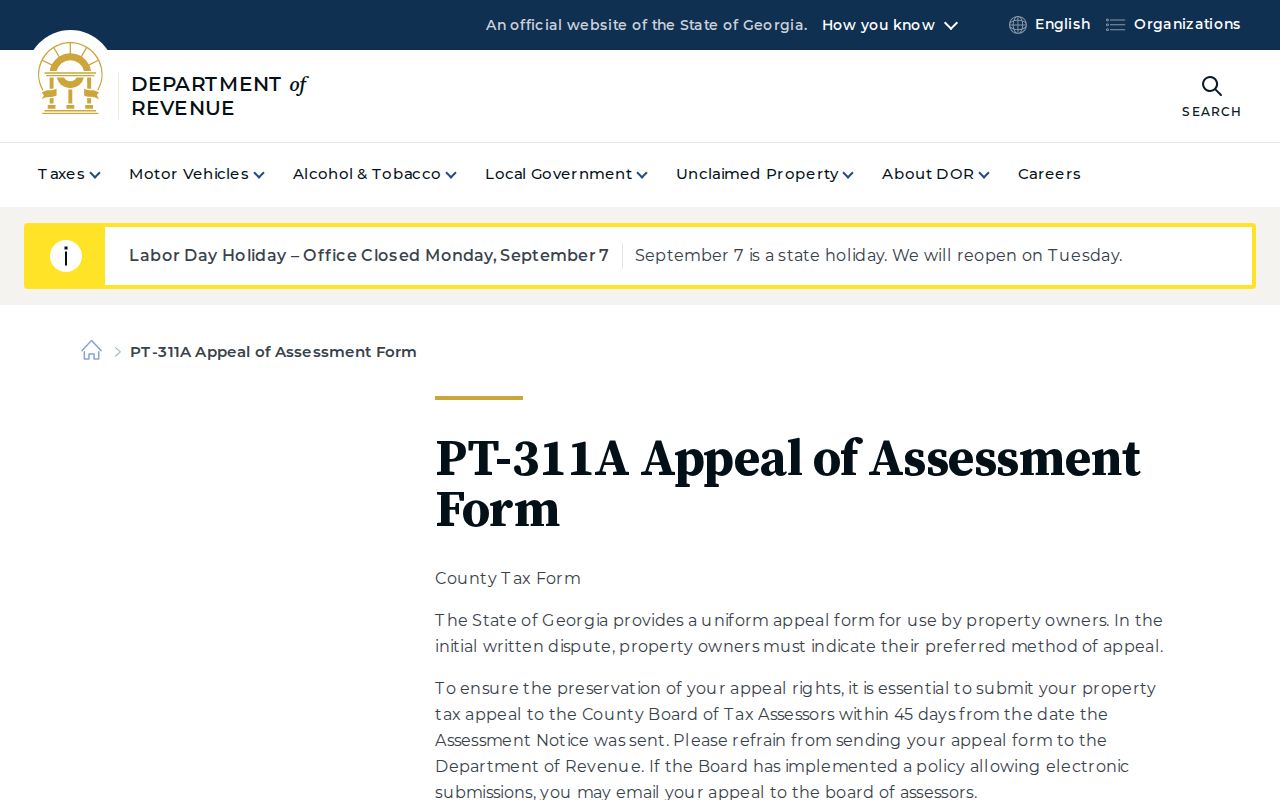
Georgia's appeal period starts with the annual assessment notice. The window runs 45 days. The Board of Equalization sits in the process. Identify the parcel and tax year. State the value or classification in dispute. Then submit evidence through the method the notice itself specifies.
Good evidence takes many forms. A recent appraisal, comparable sales, photos, repair estimates, a corrected sketch, or proof that a recorded characteristic is simply wrong all work. Save the notice, the filed appeal, and proof of delivery. The Board of Tax Assessors reviews the filing first. The matter can then move through the available appeal path.
Appeal window. File within 45 days of the assessment notice and follow that notice's delivery instructions; a tax payment portal does not file an appeal.
Exemptions on Tift Tax Records
An exemption only lowers taxable value. That happens when both the owner and the parcel meet the rule. The assessor record, not the size of the bill, is the place to check it. Age or occupancy tells you nothing on its own. The Board of Tax Assessors keeps the exemption records. The Tax Commissioner then bills on the resulting taxable figures.
Georgia's recent HB 581 and the floating-homestead changes matter here too. They set statewide context without making every account the same. Each local taxing authority can opt in or out. So confirm which exemption is actually coded on the parcel. When the card is unclear, ask the assessor for the application status and its effective tax year.
Note: A deed transfer can affect exemption status. A buyer should not assume the prior owner's relief carries forward.
Missing Tift County Tax Files
When qPublic or the payment portal will not load, skip the guessing. Use the office channels instead. The Tax Commissioner sits at 225 Tift Avenue, Suite 106, Tifton. Office hours are Monday through Friday, 8:30 a.m. to 5:00 p.m. Call (229) 386-7820. Assessor and tax staff can tie a parcel number to the correct record set.
The Tift County Open Records form handles requests. It covers any tax ledger, digest, notice, or other county-held record that is not posted online. Georgia guidance sets a three-business-day clock. The office must give an access response, time estimate, or lawful withholding statement within that window. Copying, staff time past the initial allowance, and media costs may apply.
Limits of Tift Property Tax
Property tax records prove what was assessed and collected. They are not a title report, survey, appraisal, or promise of future tax. Parcel boundaries on the map are reference geometry only. A tax mailing address does not show that the named person lives at the site. And a delinquency entry deserves a current check before anyone relies on it.
For a purchase, appeal, estate, or boundary issue, keep a dated copy of the parcel card. Keep the bill with it. Then confirm the deed, legal description, and any relevant plat. Do that with the Clerk of Superior Court. Use these records for lawful property research only. Never use them to target or harass a person.
A careful tax file should show the parcel number, situs and mailing addresses, tax year, fair market value, assessed value, exemption codes, and bill amount. It should also show the payment date and source retrieval date. If one field changes, keep the older copy as well. That record lets you explain whether a difference came from revaluation, a parcel split, a new exemption, or a corrected building characteristic. A millage change or payment posting shows up the same way. It also keeps a countywide digest trend from being mistaken for a parcel-specific change. When the issue touches legal rights, a tax sale, or title, ask the office for the current certified or official record. Get professional advice suited to the decision.
Tax-sale and delinquency questions call for a fresh office check. A published list or older bill can go stale after payment, redemption, cancellation, or correction. Record the status date. Ask the Tax Commissioner whether any sale is scheduled and what redemption information exists. Then search the clerk's recorded instruments for a tax deed or later conveyance. Do that when the ownership trail matters. Do not label a property sold or foreclosed from a delinquency clue alone.