
Identify a Tift County Owner
Tift County splits the ownership trail among three stops. QPublic, SGRC GIS, and GSCCCA each hold one piece. Use the address to reach the parcel, the parcel to reach the tax card, then the owner name and legal description to reach the latest deed. Every handoff double-checks the step before it, so a wrong turn shows up fast.
- Search the address in Tift qPublic and record the parcel number and owner-of-record name.
- Check the SGRC parcel layer for the same ParcelNum, Situs, owner label, and QPLINK.
- Search the owner as grantee in the GSCCCA Real Estate Index and identify the newest matching deed.
- Compare the legal description, recording date, and grantor with the parcel rather than relying on the name alone.
- If a company holds title, inspect its official Georgia filing for entity context, then return to the deed for ownership proof.
Tift County Owner Sources
The same name can mean different things in each public source. The tax roll carries an administrative owner field. The deed index lists parties to a recorded transfer. GIS republishes a map label, and the Secretary of State explains a registered entity without proving what land it holds.
| Source | Owner Info It Gives | Access |
|---|---|---|
| Tift qPublic | Owner of record, situs, parcel and assessment lead | Online search or assessor office |
| GSCCCA index | Grantee, grantor, instrument type, date, book/page | Online index or Superior Court clerk |
| Georgia business search | Entity status, agent, officer, control number | Free state search |
| SGRC GIS | Owner label, parcel number, situs, mapped shape | Public map and REST service |
A tax mailing address is not the situs address. Neither one proves who lives there. The named owner may be an estate, trustee, company, or a person who simply receives mail elsewhere, so write down the exact spelling the first time. Punctuation and initials change deed-index results.
Confirm the Tift County Deed
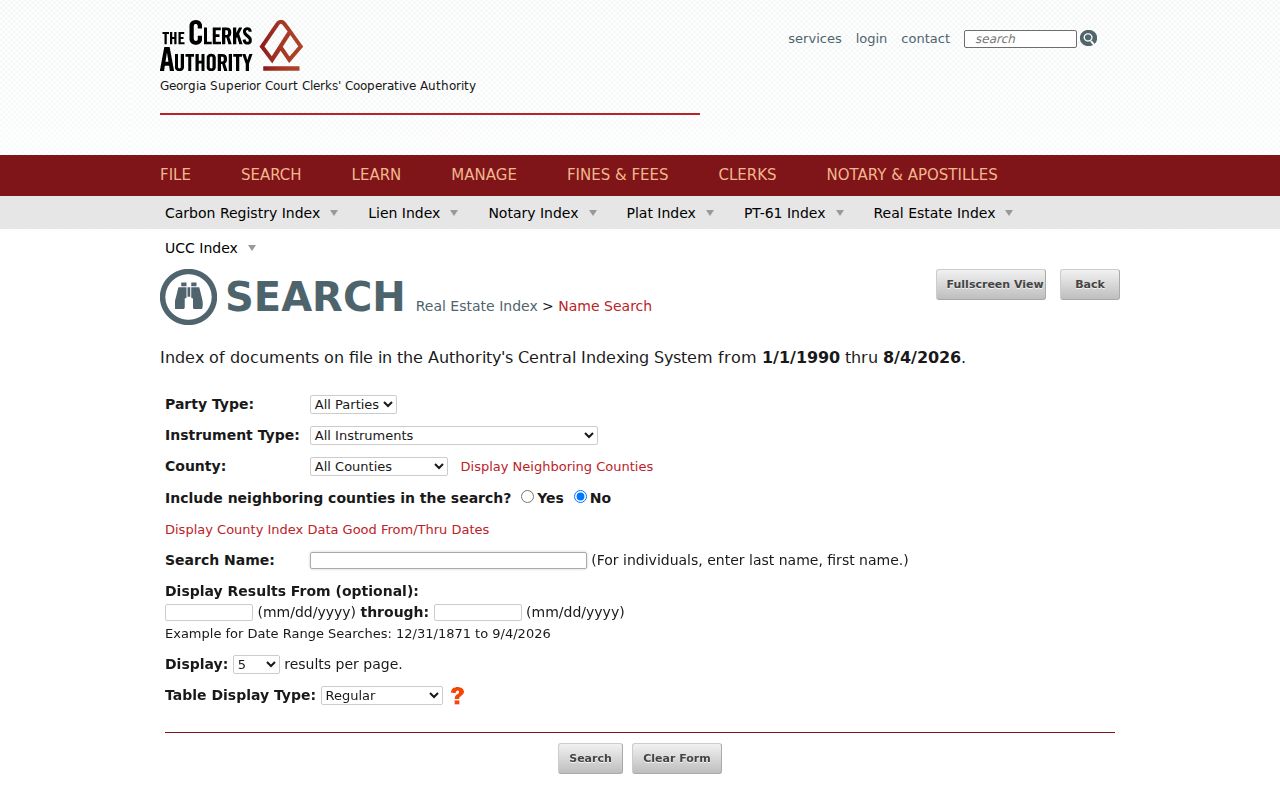
The Clerk of Superior Court serves as the county recorder. It files deeds, security deeds, releases, liens, easements, plats, and restrictive covenants. GSCCCA's name search lets you narrow your results. Filter by party type, instrument type, county, date range, and name controls. Statewide information starts from a 1999 transaction baseline. The name screen reaches back to 1990. Tift's exact good-from date and image coverage appear in the live county display.
Search the assessor's owner name as a grantee. Do not stop at the newest same-name hit. Match Tift County, the parcel legal description, grantor, instrument type, and book/page before trusting anything. A security deed reflects financing, not a new owner. A quitclaim transfers only the interest the grantor holds. It promises nothing about clear title.
Tift Owner Record Terms
Ownership research is easier when each label keeps its narrow meaning. The name in a Tift County record may not be the owner of record. It could belong to a prior owner, lender, trustee, executor, registered agent, or tax-mail recipient instead.
- Owner of record
- The name maintained in the current assessor record for tax administration.
- Vesting
- The way title is stated in a deed, including the names and form of ownership.
- Grantee
- The person or entity receiving an interest in a recorded instrument.
- Situs address
- The physical location used to identify the parcel.
- Mailing address
- The address used for notices; it may be far from the land.
For a current answer, trust the vesting deed and its matching legal description over a mailing field or map label. A deed recorded with the Tift County recorder carries the title. When competing interests remain, a title professional can sort them out.
When Tift qPublic Lags
Timing explains most ownership mismatches in Tift County property records. A recent closing often hits the deed index before the assessor updates its owner field. Access to the qPublic parcel cards can also fail at times. Do not count on any single display. Fall back on the assessor landing page. A phone call or office visit also works. So does the newest recorded deed. Compare dates. Check the deed's execution and recording dates against the assessor tax year. A mismatch may reflect routine timing. It could be an estate transfer, a name change, or a parcel split. Treat it as a prompt to investigate, not proof that either office erred. The more detailed current Tift County owner record treatment focuses on how fresh the assessor field is. It also covers how to document that check.
Company Owners in Tift County
When a Tift County deed vests title in an LLC or corporation, search the exact entity name in the Georgia Corporations Division. The state form supports Starts With, Contains, and Exact Match. It also offers control number, registered agent, officer, and designated-agent searches. An entity result can explain spelling, status, and an official agent or address. It does not prove the company still owns the parcel. Return to GSCCCA for the latest deed and any later transfers. For a trust, search the trustee name and the trust wording from the deed. Private trust terms may never appear in the public index.
Estate Ownership in Tift County
An assessor card sometimes lists an estate rather than a living owner. That name changes where the paperwork lives. Tift Probate Court handles the administration side and grants fiduciary authority. The Superior Court clerk is the office that actually records the executor's deed, administrator's deed, or deed from estate once it is filed.
On GSCCCA, the instrument list includes both DEED - FROM ESTATE and ESTATE DOCUMENTATION. Run searches on the decedent. Run searches on the executor, the estate itself, and any prior owner of record. A will or probate order shows who had authority to sell. The recorded conveyance is still the document that ties that authority to the parcel. Tift County publishes no online probate estate index. Ask Probate Court for the docket or file when the estate paper trail matters to your property records search.
Omega's County-Side Owner Check
Omega sits in two counties, Tift and Colquitt. A correct city label on an address can still mislead. It may point a property search at the wrong assessor and clerk. Start with the current GIS boundary. The parcel result tells you which county side the land falls on. Then keep that county choice attached to every assessor, tax commissioner, and deed-index note you use.
A tract's legal description can straddle the county line. In that case, search both recording systems. Compare the land lot, district, acreage, road frontage, and adjoining owners. A Tift GIS map cannot speak for a Colquitt-side parcel. Postal text is only a clue.
Older Tift County Owners
Tift County took shape in 1905, carved from Berrien, Irwin, and Worth counties. A parcel with a Tift address today may sit in a parent county's older books. So keep that in mind when you pull the earliest Tift deed. Copy its prior recording reference. Copy the full legal description too. That reference is your bridge backward.
Track the tract into the parent county the old deed points to. Then check the Georgia Archives county-card and microfilm catalog. Old maps and newspapers offer name clues. They prove nothing on their own. Only a deed, probate file, or tax record establishes the owner of record.
Note: A pre-1905 street or place name is just a lead. Land-lot and district terms usually bridge records better.
Offline Tift Owner Requests
Portals block some users, and older deed books never made it online. In that case, write the Clerk of Superior Court or the assessor with the parcel number, owner spelling, legal description, book and page if known, and a date range. Ask for an existing index entry or record. Staff cannot build a title history for you.
The Tift County records request form covers county-held material too. Under the Georgia Open Records Act, an agency generally answers within three business days with access, a cost estimate, or the legal reason a record is withheld. Copy, media, and staff-time charges can apply.
Limits of a Tift Owner Search
Public data answers who owns this property, but only partway. It will not surface every heir, spouse, lienholder, beneficial interest, resident, or unrecorded claim. GIS geometry is not a survey. A tax roll is not a title report. A business filing is not a deed.
Use owner data for a purchase inquiry, a boundary question, an estate search, a deed-fraud check, or any other lawful purpose. When legal rights turn on the answer, verify with the record custodian and a qualified professional.
Lawful use. Tift County owner records are for lawful property research; never use an owner name or address to stalk, threaten, harass, or harm anyone.